I got zucked and lived to tell the tale! Buckle up, my friends; this story is a wild ride.
On Wednesday, February 11, 2026, I was at my desk toodling along on work. I turned toward my rightmost monitor, where the internet lives on my system, to look something up—and saw a mostly black Facebook window with an ominous message that my account had been suspended.
Um . . . WHAT.
A mad scramble ensued. I was still logged in but could not access any of my Meta accounts or content on either my computer or my phone. No Facebook, Messenger, Instagram, or Threads. An email from Facebook (which I carefully determined was legit) blandly informed me:
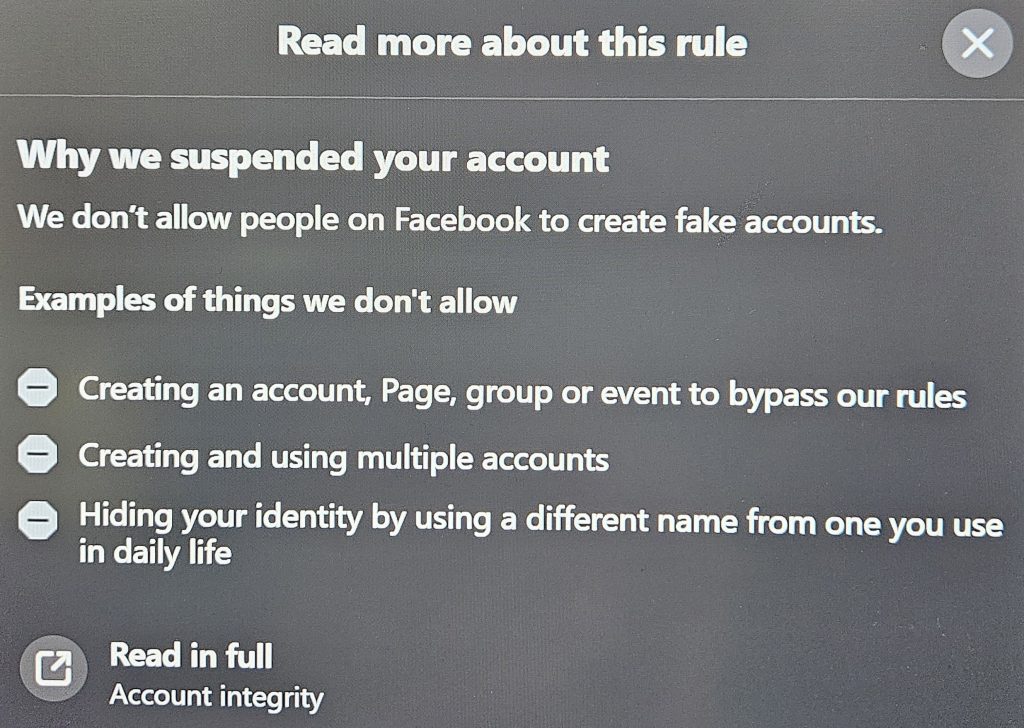
“Your Facebook account has been suspended. This is because your account, or activity on it, doesn’t follow our Community Standards on account integrity. If you think we suspended your account by mistake, you have 180 days to appeal our decision. If you miss this deadline your account will be permanently disabled.” The hyperlink for “account integrity” led to this:
I followed the “Appeal” link and had to submit a code from my phone, a photo of my face, and a photo of my ID. (Believe me, I verified that this was a legit process!) There was no option to write anything in my defense. Then this message popped up in my Facebook window and stayed there:
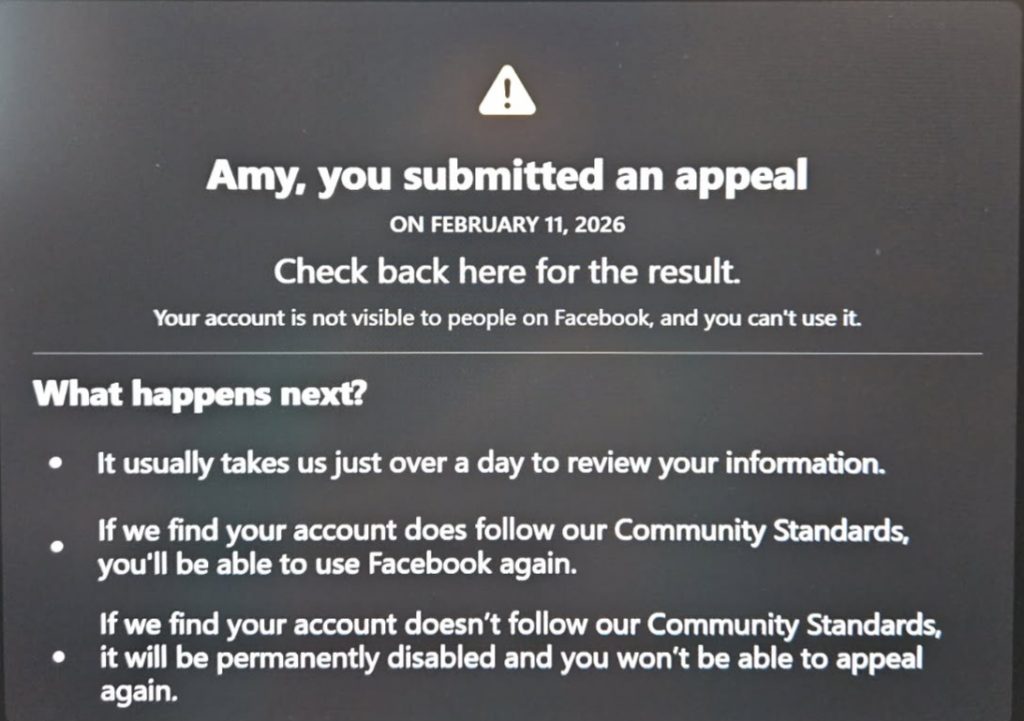
No apparent way to contact a person. I could only wait for an appeal, and if the robots decided I did break the rules, I would be nuked from Facebook permanently, with no further recourse.
Why me? And what next?
What rules did I supposedly break? First, the aforementioned “account integrity.” Another email suggested that I had violated Facebook’s advertising policies:
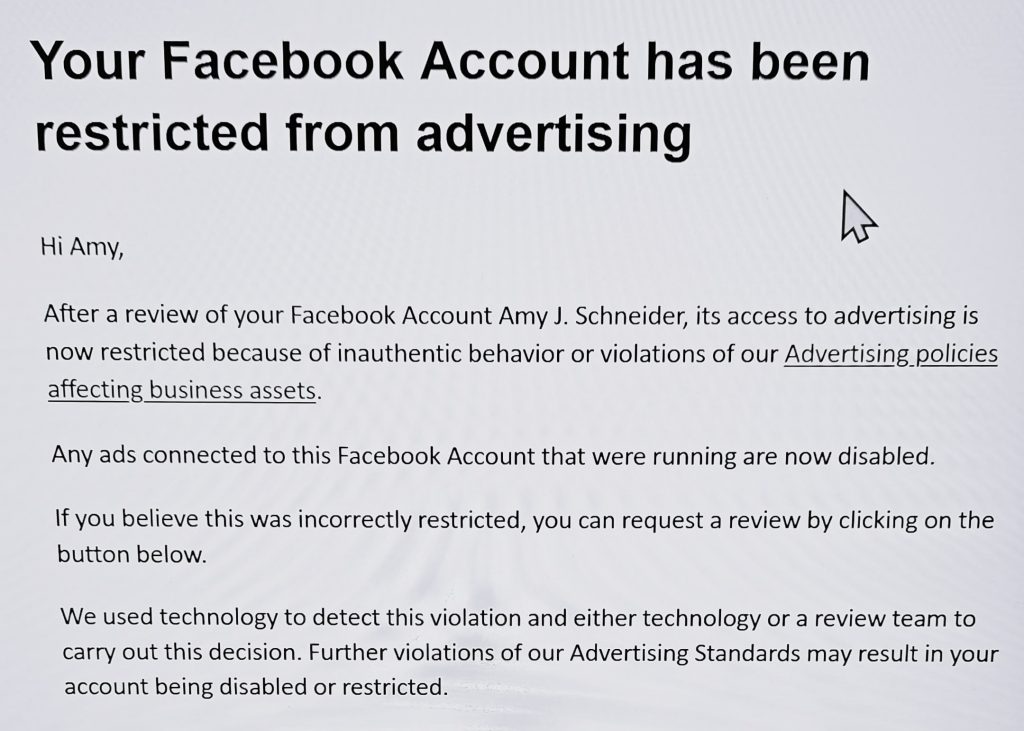
Reader, I have never created either a duplicate account or a Facebook ad (unless you count Marketplace, and I hardly think my tablecloth collection counts as inappropriate).
It had to be a glitch, right? I got on WhatsApp and contacted a friend who works for Facebook (though not in a capacity where she could help me), and she agreed that it was likely a glitch and advised me to stay logged in. Nothing to do but wait.
Well, and start investigating on my own. Several Reddit threads were informative . . . and scary. Many people reported having their accounts banned and never getting them back. Some tried opening new accounts and were instantly banned again. Others reported their accounts magically coming back after a few days, or weeks, or months, either on their own or after a protracted battle. I learned that there are email addresses where you can supposedly reach a person (ap*****@**.com and di******@**.com), but opinions were divided on their effectiveness. Overall, the community agreed with my friend that I should just sit tight and wait.
The implications of being banned from Meta
The realization slowly started to sink in. Suddenly I had lost contact with so many groups of people. My Facebook editing communities, where I ask for and give advice and stay visible to promote my book. My business Facebook page (not terribly active, but still, unreachable now). Writers and creators that I follow on Facebook. People from the dog training world: friends, online groups, people from my dog training club, access to event announcements, ongoing group chats. A local social group (I had non-Facebook contact info for only one person). Many dear online friends with whom I’m connected only on Facebook. Marketplace and all of my listings. A Facebook group where I give away items as I declutter after moving. My dogs’ Facebook pages (which have a small but enthusiastic following and are promoted on their cards that I give out to people). Local community events and business pages. I was hosting a party that Friday, and it was a Facebook event. I was horrified to remember that several guests had never been to my house before, and what would they think when the event disappeared, but then I remembered that I had made a friend a host so she could invite people too. Whew.
So many people and organizations operate only on Facebook; it’s become a default channel.
The same goes for Messenger. Communication with all of my Facebook-only friends was suddenly cut off. To them I had disappeared. Several worried that I had blocked them. I no longer had access to my chat history with my deceased mother, or the family chat with her and my sister, including our discussions during my mother’s brief illness before she died. (And also my mother’s still existent Facebook page and all her posts and photos, many of which I had saved already, but still.) I seemingly had no way to communicate with scads of people to even tell them what happened. I’d lost Instagram and Threads as well. I’m not very active on those platforms, but still, channels lost. It’s not a good look if someone follows a link to my business Instagram page and it’s not there.
Damage control
I started with (of course) the Quad. I went to our Slack space and reported that I’d gotten zucked. They were as horrified and confused as I was, and agreed to help get the word out that I had not fallen off the planet. I belong to a few other editing groups on Slack and let them know as well.
Next I got on LinkedIn and Bluesky to report my absence on Meta. With that I had done what I could to let the online world at large that I was still here.
After that it got tedious: texting and emailing dozens of individual people. My sister. Friends. Asking them to contact other people and any group chats we were in to give them my email and phone number. I had to ask a friend to let my party co-host know what happened because I didn’t have her number.
Next was finding the other accounts of creators I usually follow on Facebook only: on Substack, TikTok, and so on. Each one that I remembered reminded me of others I wanted to find. It was pretty time-consuming.
I was still logged into my Facebook account, but I couldn’t do much. I couldn’t see any of my content. On the top bar I had the blue Facebook logo, my profile picture, my name, and a menu with “Download my info,” a slider for dark mode, and “Log out.” That’s it. “Download my info” sounded promising, but it produced only basic profile information like my name, email address, and phone number (which were correct, which my friend told me confirmed that my account had not been hijacked by a bad actor). So that was a dead end.
Meanwhile, as I got back in contact with people, I learned that my past chats with some of them were still visible, but all of my messages had been replaced with something like “This message has been removed because it doesn’t meet our Community Standards.” The “problematic” messages were of course things like “let us know when you get home.”
And despite all my efforts, there were a few people who were just completely lost to me.
As I frantically tried to rebuild my communities and connections, I discovered an app called WebCatalog (https://webcatalog.io) that lets you mimic desktop apps for hundreds of platforms in your browser. I was juggling LinkedIn, Bluesky, Substack, TikTok, Google Messages (for text messages), WhatsApp, Signal, and others, and rather than having a bunch of windows with the Chrome logo, each platform’s Chrome tab shows its logo, making them much easier to identify at a glance. It was a lifesaver.
And of course, in the middle of all of this, I was bogged down in work! I was having lots of individual conversations on different platforms and it was exhausting. At the same time I felt discombobulated and disconnected from society in general.
The resolution and lessons learned
On the morning of the following Thursday, February 19, my Facebook account magically reappeared. Huzzah! I also received an email explaining that my case had been reviewed and I was found not to be in violation of any rules. (You don’t say.) My account was restored, go forth in peace, live long and prosper.
First things first: A quick and joyous announcement of my return. I acknowledge that Facebook has its problems, and many people have left the platform because of them, but for now I still find it useful, especially for local social and community connections. So I’m staying for the foreseeable future.
Next up: Get at least one other trusted admin on my Facebook pages, so if I disappear again, my pages don’t. A friend and my spouse on my dogs’ pages, my spouse on my Facebook page, and so on. And from now on I will always have at least one other admin or host on my events and any new pages I create.
I also downloaded my actual Facebook data, to preserve my chat history with my mother.
By now I had obtained phone numbers and emails for other friends, and I’m still working on that. I’ve learned the hard way not to rely 100% on Facebook for staying in touch with even local friends.
I’m also working on keeping up with communities and creators on other platforms. It can be easy to let them slip out of your view, but I found that it’s important to stay in touch.
Final thoughts
So I survived getting zucked. But the experience was definitely food for thought. Facebook has become a near universal communication channel. But there’s no viable alternative with the same features: private messages, group chats, private groups, marketplace, and so on. You can change your email address or phone number and still connect with people through those means. But if you live most of your digital life on Facebook and then are suddenly ejected from the platform, you essentially disappear. It works great until it doesn’t. So don’t get complacent. If you are largely a Facebook denizen, think about creating and collecting backup communication methods; join groups on other platforms; add extra admins to cover your pages, groups, and events that you create, and so on. Build redundancy in your digital life so you’re prepared if (or more accurately, when) a system goes down.
Amy J. Schneider has been a full-time freelance copyeditor and proofreader of fiction and nonfiction and owner of Featherschneider Editorial Services since 1995. Her projects have included textbooks, trade nonfiction, and university press books on a variety of subjects, as well as more than 600 novels and anthologies for traditional publishers, including multiple series works and best sellers in a variety of genres. She is the author of The Chicago Guide to Copyediting Fiction (University of Chicago Press, 2023).